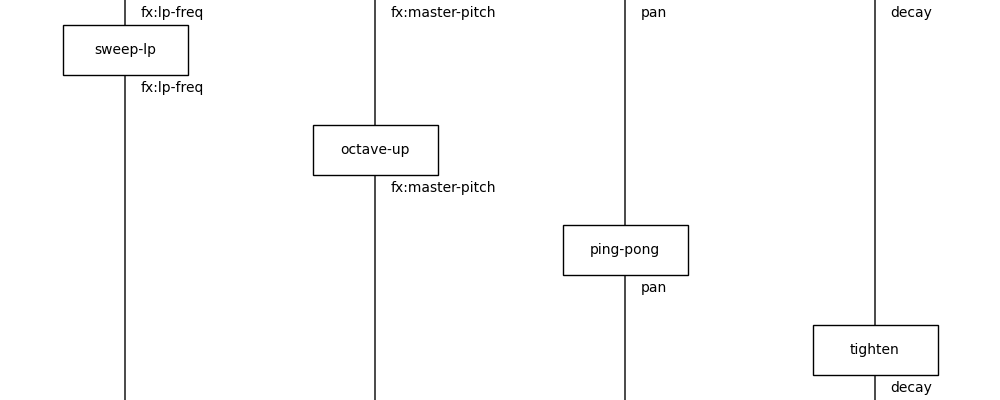
Auto-DJ tick — five compatible macros, parallel-composed
One macro from each of FX / Pitch / Pan / Shape / Feel families that lands on disjoint wires. This is the largest stack the runtime can fire concurrently without a wire collision. Auto-DJ's stack-N parameter is bounded above by this picture.
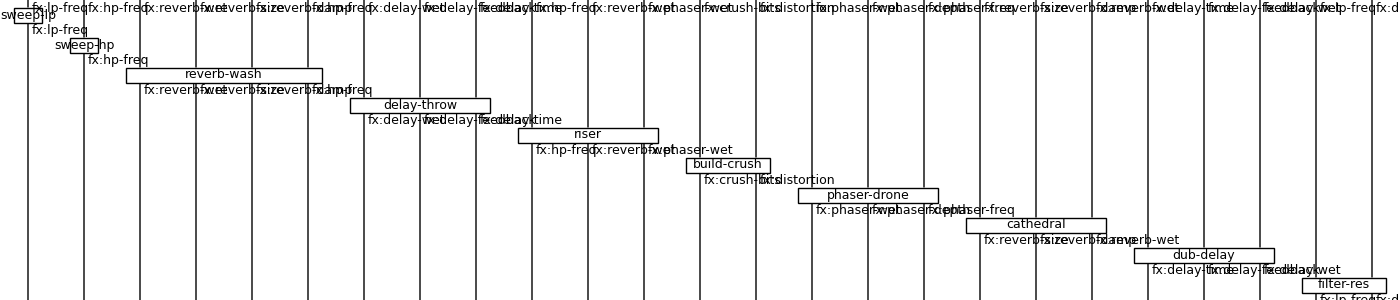
FX family — 13 disjoint wires
Every fx-sweep / fx-hold macro is typed by the fxKey(s)
its ops touch. reverb-wash @ delay-throw
typechecks (different wires). Two macros that both touch
reverb-wet can't parallel-compose — one wins, the other is
sequential. The diagram shows each macro on its own wire(s); the
gaps between them are the parallel-composability contract.
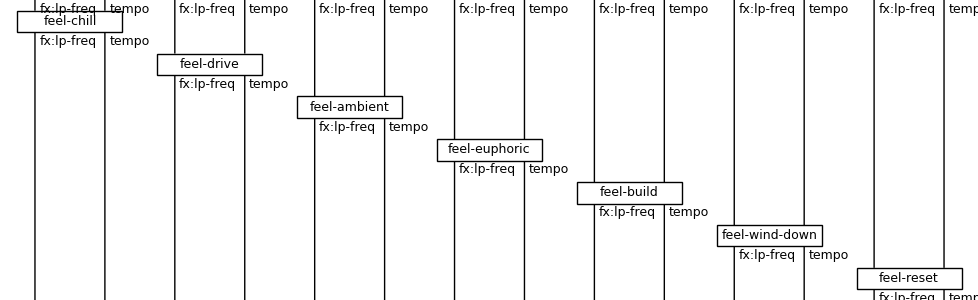
Feel family — touches lp-freq + tempo
Feel macros write the master LP filter and the BPM, so they
conflict with both FX (specifically lp-freq) and Tempo
macros. The two-wire dom captures that — try parallel-composing a
Feel macro with sweep-lp or half-time and DisCoPy refuses.
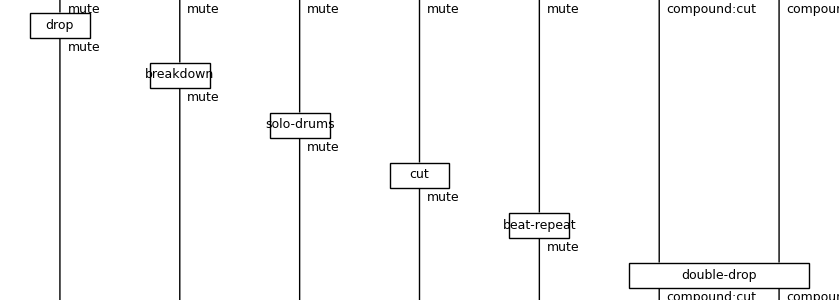
Mute family
All mute macros consume the mute wire, so they're sequential
with respect to each other. The compound macros (double-drop)
live on dedicated wires that name their composing steps.
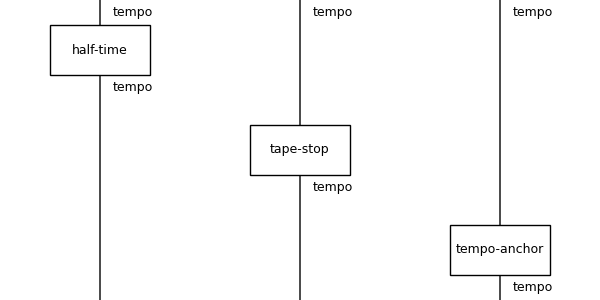
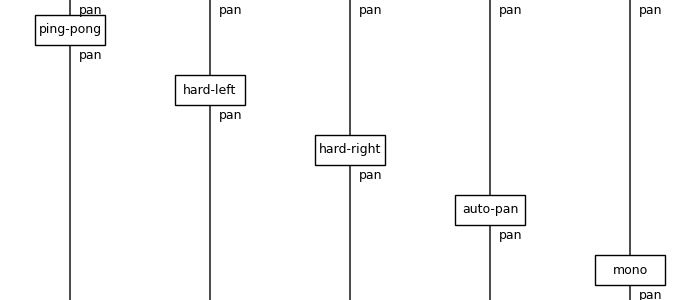
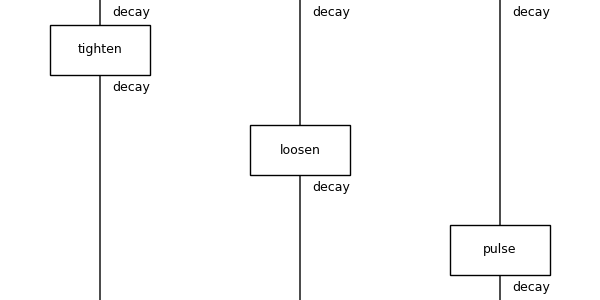
Tempo · Pan · Shape · Pitch
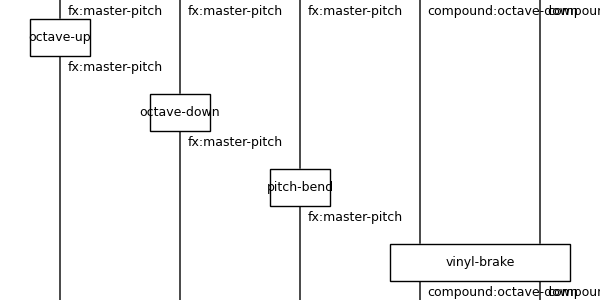
Each on a single wire — within-family macros conflict, cross-family
macros parallel-compose freely. Pitch is interesting: it's
implemented through master-pitch's FX wire, so a Pitch macro
and an FX macro touching master-pitch conflict — but Pitch +
any other FX macro is fine.
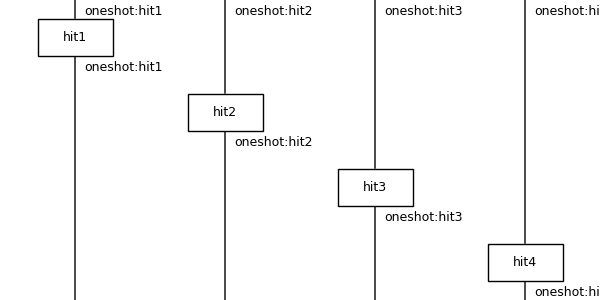
Hits (one-shot) — 4 independent pad wires
All four Beats-tab Fire pads are mutually parallel-composable: each
gets its own oneshot:hitN wire. The runtime confirms — you can
mash all four simultaneously and they don't step on each other.